
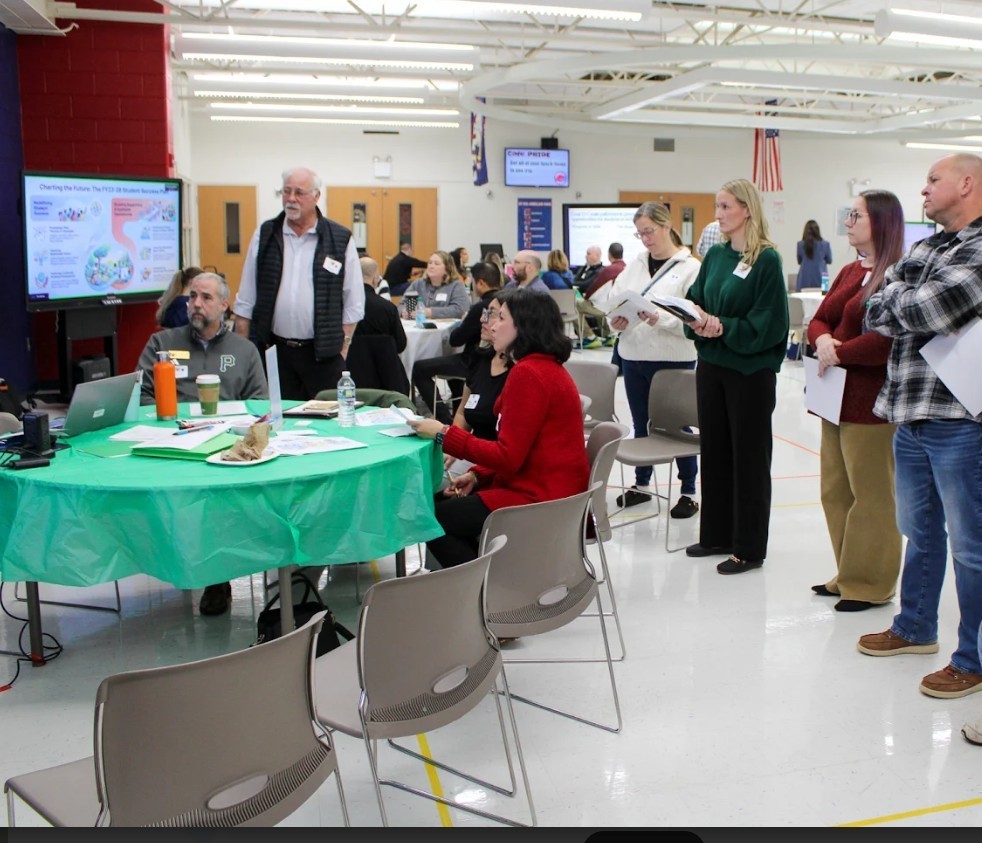
District 202 recently brought together 55 community members and student leaders for an annual update and conversation on the District’s 2023–2028 Strategic Plan. District administrators and staff shared progress on strategic goals and invited community input to help guide next steps.
The special meeting, held Saturday, January 10, 2026, at Ira Jones Middle School, included presentations, small-group discussions, and interactive activities focused on long-term facility needs, fiscal responsibility, and future investment priorities aligned with the Strategic Plan.
Participants were also asked to rank a list of priorities related to facilities, academic programs, and enrollment growth.
“Our goal is to plan responsibly for the future while keeping students at the center of every decision,” said District 202 Superintendent of Schools Dr. Glenn Wood. “Community voice is critical as we evaluate how best to maintain our facilities, expand opportunities for students, and ensure long-term financial stability.”
District 202 parent and CAPE president Blair Kramer attended the meeting. CAPE is District 202’s committee for the Coordination of Administration and Parent Groups for Educational Efficiency.
“As a parent in District 202, it is reassuring to see the progress the District has made with its Strategic Plan,” Kramer said. “It is also encouraging to see the District being transparent and proactively seeking meaningful engagement with community members on options, ideas, and priorities as the District plans for growth and future challenges.”
Planning for Tomorrow: A Strategic Vision for District Facilities
During the session, District leaders outlined key categories of long-term facility needs and planning considerations, including:
• Maintaining District Facilities: Ongoing capital improvements such as roof replacements, heating and cooling systems, upgrades, and safety enhancements to protect existing investments and ensure safe, functional learning environments.
• Expanding Critical Programs: Potential development of a new Early Childhood Center, a Career & Technical Education (CTE) Center, and a dedicated Transition Center to support college, career, and post-secondary readiness for students, including those with disabilities.
• Modernizing Learning Spaces: Improvements and modernization at Plainfield High School–Central Campus to address aging infrastructure and create equitable, state-of-the-art learning environments. The building lacks several learning and support spaces that are standard at other high schools in the District.
• Addressing Enrollment Growth: Planning for new middle school, elementary, and early childhood facilities to support projected enrollment increases while maintaining smaller class sizes.
“Our responsibility as a Board is to plan ahead while listening carefully to our community,” said Board of Education President Rod Westfall. “These conversations help ensure that any future decisions are thoughtful, transparent, and focused on what is best for students and the community.”
Addressing Overcrowding: Current Actions and Future Planning
District leaders noted that the Student Attendance Boundary plan approved by the Board of Education on December 17, 2025, represents an initial step to address overcrowding and projected enrollment growth.
The approved changes, which take effect in the 2026–27 school year, will not be affected by future facilities planning decisions and include moving students from Plainfield North High School to Plainfield East High School and Plainfield High School–Central Campus.
Elementary and middle school boundary changes will be considered later, following additional research and discussion on community priorities and facility needs.
Responsible Fiscal Management
The District demonstrates strong financial stewardship, with more than 92 percent of expenditures supporting instruction and student services.
District 202 has earned top recognition from the Illinois State Board of Education and an Aa2 credit rating from Moody’s Investors Service, reflecting low credit risk and a strong capacity to meet its financial obligations.
Despite this responsible management, District 202 was among a number of schools moved from Tier 1 to Tier 2 by the Illinois Department of Education, resulting in an annual reduction of $7 million in state funding. Over time, this funding change will have a cumulative impact on District finances and require adjustments to current and future budgets.
To responsibly address current and future priorities, the District is evaluating a range of funding options including the use of capital reserves, grants, bond issuance or tax rate adjustments. The community would need to vote on a bond issuance or tax rate adjustments as part of a referendum.
“We have an obligation to stay informed about how proposed solutions could affect our community, whether or not we have children in the District,” Kramer said. “Strong schools are essential to the long-term success and prosperity of our entire community.”
Next Steps
District 202 will continue to seek feedback on priorities and next steps. The District will continue to seek community feedback through surveys and future engagement sessions to inform long-term planning decisions.
Residents are encouraged to visit the District’s website at https://www.psd202.org/page/district-planning-and-progress for the latest updates and information.